



|
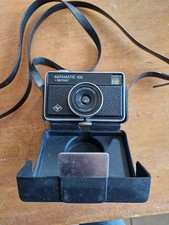
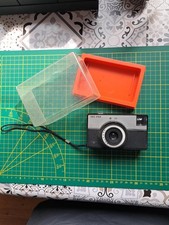
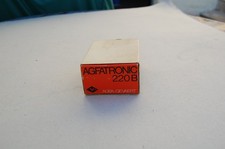
Agfa Optima Rapid 500 V |
 Version française Version française |
Manufactured or assembled in Germany from 1967 to (Circa) 1970.
Index of rarity in France: Infrequent (among non-specialized garage sales)
Inventory number: 12328
See the complete technical specifications
Chronology of cameras Agfa
Starting in 1964/65, Agfa released four lines of cameras using the Rapid system. These are:
Iso-Rapid, simple cameras giving 16 exposures of 24 x 24 mm.
Isomat-Rapid, cameras giving 16 exposures of 24 x 24 mm. They are capable of detecting the film sensitivity to provide information to the exposure meter.
Silette Rapid, mid-range cameras using 24 x 36 mm format.
Optima Rapid, high-end cameras giving 36 exposures of 24 x 36 mm.
There are four models of Optima-Rapid:
| Flash | Shutter | Lens | ||
| Optima Rapid 125 C |  |
Flashcube | Paratic | Apotar 2.8/35 |
| Optima Rapid 250 |  |
Hot Shoe | Optima-Rapid 250 | Agnar 2.8/45 |
| Optima Rapid 250 V |  |
Hot Shoe | Paratic V | Apotar 2.8/35 |
| Optima Rapid 500 V |  |
Hot Shoe | Paratic V | Solinar 2.8/35 |
The Optima Rapid are the high-end models using the Rapid cartridge.
There is an unusual hurry from Agfa for this series. There are two completely different shapes, and the Optima Rapid 250 is quickly replaced by the Optima Rapid 250 V to have a family resemblance again.
The Optima Rapid 125 C accepts flashcubes, but at the cost of a modification that looks like a DIY job.
The Optima Rapid 500 V was presented at the same time as the Iso-Rapid Ic, the Isomat-Rapid C, and the Optima Rapid 125 C in 1966 at the Kina trade fair.
The 500 V has full automation that can be disengaged for long exposures and flash photography. The automation allows for speeds up to 1/500 (hence the name). In the viewfinder, a green/red signal indicates the exposure quality.

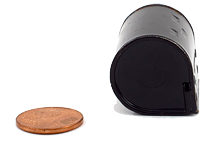
By launching the Rapid system, Agfa was in a way updating the Karat system. It is a 35 mm film in a cartridge without a central spool. The film is driven only by the teeth of a capstan that engage in the perforations of the film. It is thus taken out of the supply cartridge and pushed into the take-up cartridge. There is no need to rewind at the end of the film, as the two cartridges are strictly identical. On the cartridges there is a small metal tab, of varying length depending on the film speed. It is interpreted by certain camera models to transmit the film speed value to the exposure meter. If one reads the article below carefully, one realizes that Kodak is not among the brands mentioned; the American company has just launched the 126 cartridge, and all this looks like an anti-Kodak front.
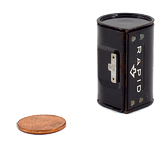
Presentation of the Rapid system, in 1964:
During a press conference held on May 6 in Frankfurt am Main, representatives of the following European photographic firms: ADOX, AGFA, BALDA, BILORA, BRAUN, DACORA, FERRANIA, GEVAERT, ILFORD, PERUTZ, REGULA, ROLLEI, VOIGTLANDER and ZEISS IKON unveiled to delegates of the European trade press a new camera loading method called the RAPID SYSTEM.
This RAPID designation characterizes a new instant film loading system allowing photography to be simpler, safer and faster thanks to the following advantages: simple insertion of the film, automatic film engagement, automatic setting of the film speed for cameras with automatic exposure control (from 15 to 27 DIN), no rewinding, camera quickly ready for operation, quick film change, exceptional sharpness thanks to a pressure plate ensuring perfect film flatness.
A single film length is provided, allowing: 12 exposures in 24 x 36, 16 exposures in 24 x 24 and 24 exposures in 18 x 24.
At the time this issue of the magazine is published, the light-sensitive materials as well as the cameras currently adapted to the RAPID SYSTEM will be officially launched to the public.
Let us now review, in alphabetical order, the firms that are already able to supply the new RAPID cartridges to photographic retailers:
ADOX. - The Adox program concerning light-sensitive materials using the RAPID SYSTEM includes: Adox KB 17 RAPID and KB 21 RAPID in 12 exposures 24 x 36, 16 exposures 24 x 24 or 24 exposures 18 x 24. These emulsions have the same qualities as the already well-known 35 mm films.
AGFA. - The range of light-sensitive materials is as follows: Agfa Isopan Rapid 17 DIN. The film for brilliant black-and-white photos when the light is favorable. - Agfa Isopan ISS Rapid 21 DIN. The film for black-and-white photography when the light is unfavorable. - Agfacolor CN 17 Rapid. The universal film for black-and-white and color photography. - Agfacolor CT 18 Rapid. The film for slides with luminous colors and for brilliant CT prints.
FERRANIA. - The Italian firm has planned: the black P 30 RAPID emulsion and two color emulsions: Ferrania negative Rapid N 27, Ferrania reversible color DIA 28 of 50 ASA.
GEVAERT. - On July 1 the Belgian firm Gevaert will present on the market four types of film: Two in black-and-white, Gevapan 27 Rapid and Gevapan 30 Rapid; two in color, the Gevacolor N 5 Rapid negative and the Gevacolor R 5 Rapid reversible.
ILFORD. - The English firm Ilford has planned black-and-white and color emulsions with the RAPID SYSTEM.
PERUTZ. - Three types of film will be supplied by Perutz: Two black-and-white emulsions, Perutz 17 Rapid and Perutz 17-21 Rapid, and the reversible emulsion Perutz Color Rapid C. 18.
As we have just done for the light-sensitive materials, we now present the cameras that will be equipped with the RAPID SYSTEM:
ADOX. - As early as 1965 the firm Adox has planned a program of cameras equipped with the RAPID SYSTEM.
AGFA. - Agfa, which played an important role in the development of this new system, can already present three Rapid cameras: Agfa Iso-Rapid I 24 x 24: The pocket camera, small and elegant, a true miniature format, bringing photography within everyone's reach. Simple, safe, fast and convenient. Insert the Rapid cartridge, the film engages by itself, release the shutter, no rewinding. 16 exposures 24 x 24 mm. Large bright viewfinder. Rapid thumbwheel for instant film advance, frame counter, flash contact. - Agfa Iso-Rapid IF 24 x 24: Just as compact and handy as the Iso-Rapid I, but with the added feature of a built-in flash (instantly ready for use). - Agfa Silette-Rapid 24 x 36: The miniature-format camera produced in millions of units worldwide.
DACORA. - The firm from Reutlingen will be able, as of July 1, to deliver 2 models equipped with the RAPID SYSTEM: the D101 Rapid camera and the D202 Rapid. The D101 Rapid in the classic 24 x 36 format is a fixed-focus camera, equipped with a flash socket and allowing 12 images in 24 x 36 format. - The D202 Rapid is equipped with an anastigmat lens and a focusing system marked by three symbols. It allows 12 photographs in 24 x 36 format.
FERRANIA. - Plans for 1965 two camera models equipped with the RAPID SYSTEM: the Lince Rapid and the Eura Rapid.
ILFORD. - Has developed a camera equipped with the RAPID SYSTEM, the Sportina Rapid.
REGULA. - The new Regula SL will see its possibilities enhanced by being equipped with this new system. Here are its technical specifications: functional combination - shutter speed: aperture from 1/30 sec - f/2.8 - up to 1/250 sec - f/16 - adjustment by a single ring with superimposed subject and lighting symbols - setting provided for film speeds from 1 to 25 DIN.
The adoption by major European firms of a rapid camera loading system can only have a positive influence on the development of photography and bring new enthusiasts to discover all its joys.
Let us add that, besides the firms listed above, ten Japanese manufacturers such as FUJI, KONISHIROKU, MAMIYA, MINOLTA, NIPPON, OLYMPUS, PETRI, RICOH, YASHICA have also decided to adopt the RAPID SYSTEM in the near future.
Contacts have also been made with manufacturers across the Atlantic.
Interesting links or bibliography :
Add a link or element of bibliography, a picture taken with this camera, a picture of box or an ads about this camera
Your photos taken with the same camera:
Cameras from Ebay France (Agfa) (Uploaded each 3 hours)